⚙️
Specifications
Core Material
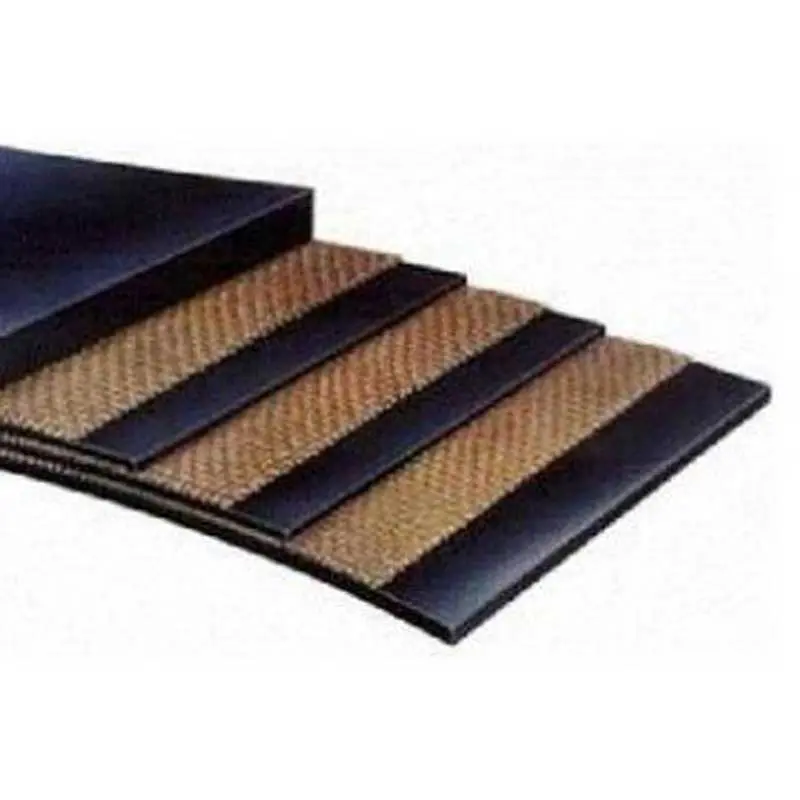
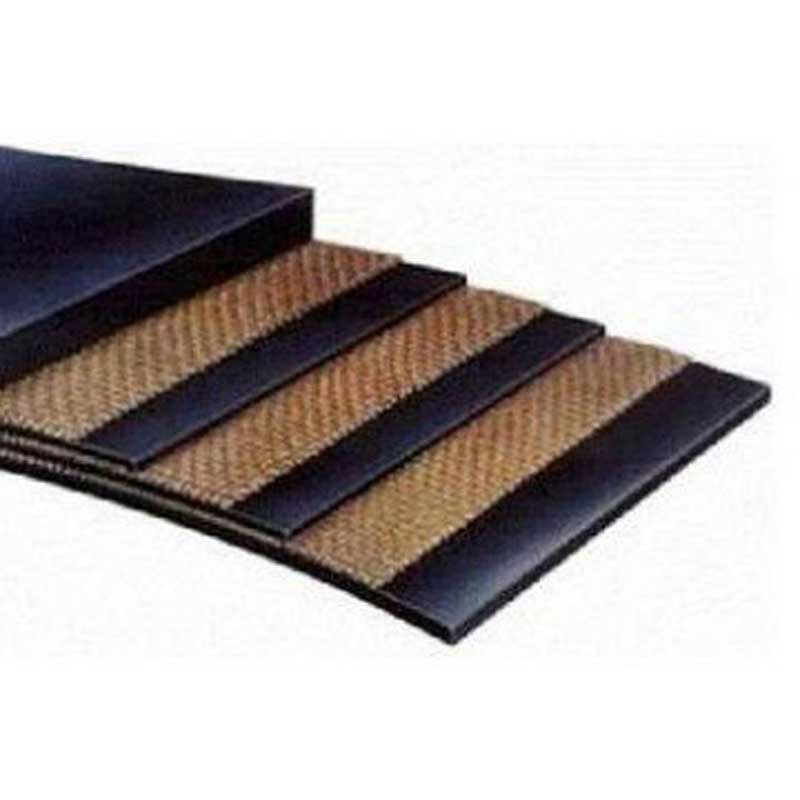
Polyester cotton interwoven fabric TC-70 type, all cotton canvas CC-56 type
Bandwidth
300mm – 3000mm
Fabric Layers
1 – 12 Layers
Cover Adhesive Thickness
Working: 1.5–10mm | Non-working: 0–6mm
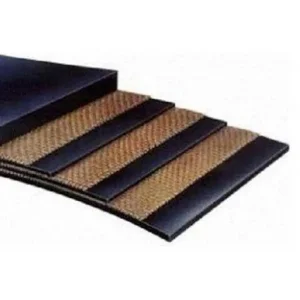
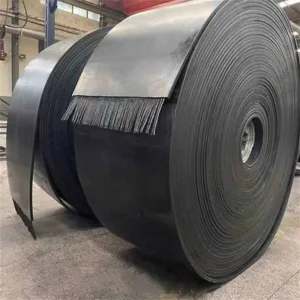
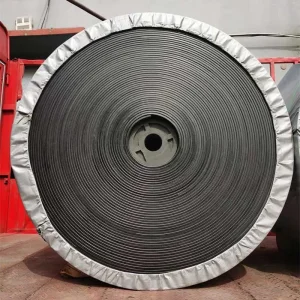
This type of conveyor belt uses fiber fabric as the core and general rubber as the covering material, with a smooth and flat surface. The core is a layered or integral fabric woven from fibers such as cotton, nylon, polyester, or vinylon.
⚠️ Cotton Fiber: Earliest used core material; easy to bond with rubber. Strength slightly increases when wet, but breaking strength is low (mostly around 56 N/(mm·layer)). Poor anti-corrosion and mildew resistance — use is gradually decreasing.
Starting from the late 1950s, nylon fiber fabrics were used as core materials and have become the most widely used type. Nylon fiber has a strength of up to 700 N/(mm/layer), is water-resistant, corrosion-resistant, and resistant to bending fatigue; however, the elastic elongation is relatively large.
Polyester fiber has similar properties to nylon fiber, but its elastic elongation during use is only half that of nylon fiber, making it a promising material for development. Vinylon fiber has a strength of 200 N/(mm·layer), a smaller elastic elongation than nylon fiber, is easy to bond with rubber, and has good heat resistance. However, its strength decreases by 10–25% when wet, and it is only used in a few countries such as China and Japan.
When weaving the core, only one type of fiber can be used, or two types of fibers can be blended or interwoven.
📋
Supplementary Information
Ordinary conveyor belts are divided into many specifications and models according to different usage environments and requirements:
- By Width (B = width in mm): B300, B400, B500, B600, B650, B800, B1000, B1200, B1400, B1600, B1800, B2000
- By Usage Environment: Heat-resistant, cold-resistant, acid & alkali resistant, oil-resistant, and food conveyor belts. The minimum upper cover thickness for standard and food belts is 3.0mm (lower: 1.5mm); for heat/cold/acid-alkali/oil-resistant belts, minimum upper cover is 4.5mm (lower: 2.0mm). Thickness can be increased by 1.5mm based on specific environment.
🌡️
Temperature Range
Continuous operation from -73°C to +260°C
⚡
Electrical Performance
Good insulation & high breakdown resistance
🧪
Chemical Resistance
Better resistance to various chemical substances
📐
Dimensional Stability
Stable; not easily deformed under high temp & pressure
🏷️
Execution Standard: GB/T7984-2001
📦 Covering Layer Performance Requirements:
Tensile strength ≥ 15 MPa | Elongation at break ≥ 350% | Wear amount ≤ 200 mm³
Average interlayer bonding strength (longitudinal) ≥ 3.2 N/mm between layers
Bonding strength between cover adhesive and layers ≥ 2.1 N/mm
According to the purpose of use, conveyor belts can be divided into the following types:
Oil Resistant
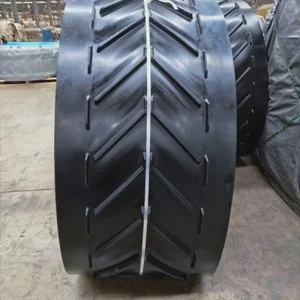
Anti-Skid
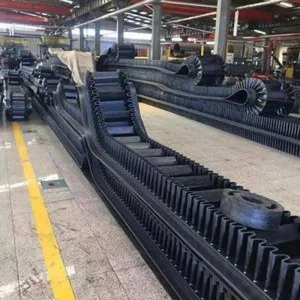
Climbing
Acid & Alkali Resistant
Heat Resistant
Cold Resistant
Flame Resistant
Corrosion-Resistant
Moisture-Proof
Low-Temperature Resistant
High-Temperature Resistant
Flame Retardant
💬
Frequently Asked Questions
What core materials are used in general conveyor belts?
General conveyor belts use fiber fabric cores made from cotton, nylon, polyester, or vinylon. The most widely used is nylon fiber, which offers high strength (up to 700 N/mm/layer), water resistance, and good bending fatigue resistance. Polyester is also popular due to its low elastic elongation during use.
What bandwidth options are available for general conveyor belts?
General conveyor belts are available in bandwidths ranging from 300mm to 3000mm, covering common models such as B300, B400, B500, B600, B650, B800, B1000, B1200, B1400, B1600, B1800, and B2000, where "B" represents the width in millimeters.
What is the recommended cover adhesive thickness for heat-resistant conveyor belts?
For heat-resistant, cold-resistant, acid & alkali resistant, and oil-resistant conveyor belts, the minimum upper cover adhesive thickness is 4.5mm and the minimum lower cover adhesive thickness is 2.0mm. These can be increased by 1.5mm depending on the specific usage environment.
What temperature range can the new material general conveyor belt withstand?
The new material general conveyor belt can operate continuously in a temperature range of -73°C to +260°C, making it suitable for both extreme cold and high-temperature industrial environments without significant deformation or performance loss.
What quality standard do general conveyor belts comply with?
General conveyor belts comply with the Chinese national standard GB/T7984-2001. Key performance requirements include tensile strength ≥ 15 MPa, elongation at break ≥ 350%, wear amount ≤ 200 mm³, and interlayer bonding strength ≥ 3.2 N/mm.
What structural types are available for general conveyor belts?
General conveyor belts can be manufactured in various structural types to suit different usage conditions, including edge wrapped, open edge, middle ladder, and edge ladder structures. The belt is produced through rolling, forming, and vulcanization processes using cotton canvas (CC) or nylon/polyester (NN/EP) materials.
 Boao Rubber